A Filipino Holy Week Tradition of Faith and Reflection
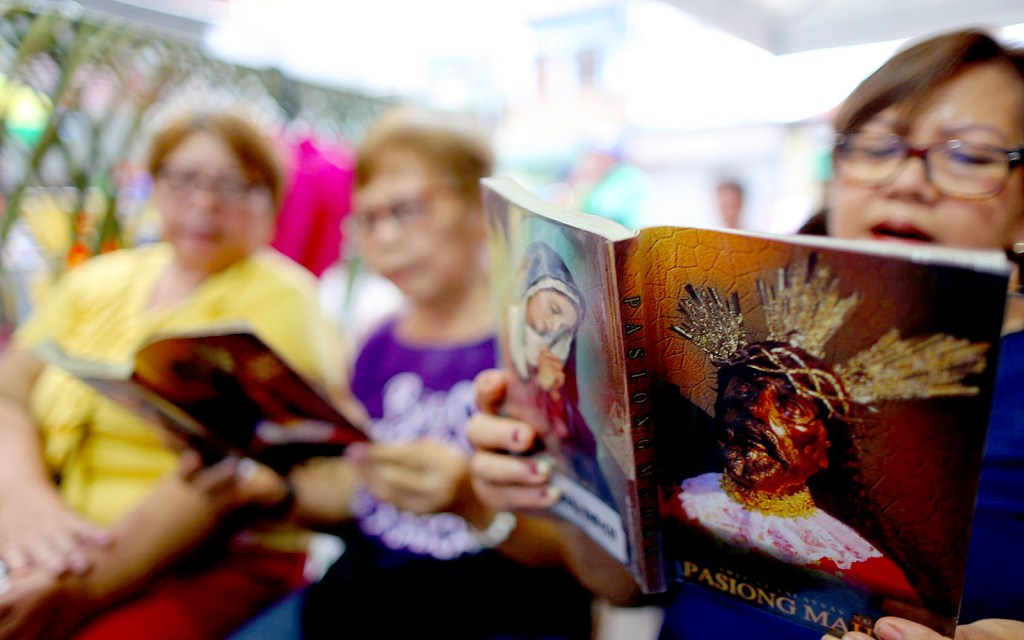
Every Holy Week, in many Filipino homes and chapels, you’ll hear the rhythmic, almost hypnotic chanting of verses that tell the greatest story ever told. It’s called the Pabasa ng Pasyón—a uniquely Filipino devotion that has endured for centuries. Some chant it out of deep faith. Others continue it as part of family or community custom. And some might quietly wonder: is it still meaningful today?
The Pabasa is a form of popular devotion rooted in our Catholic heritage, centered on a poetic narrative of Jesus’ life, passion, death, and resurrection. Known as the Pasyóng Mahal, the most widely used version was composed by Gaspar Aquino de Belén in the early 1700s. Written in Tagalog verse, the text beautifully recounts the story of salvation and was meant to be sung in community, not just read in silence.
The chanting is not just a performance—it’s an offering. It is a way of proclaiming, in our native tongue and style, what St. Paul boldly declared:
“We proclaim Christ crucified…” (1 Corinthians 1:23)
“Faith comes from hearing, and hearing through the word of Christ.” (Romans 10:17)
For many generations, the Pabasa served as a form of catechesis for Filipino Catholics, especially when the Bible wasn’t readily available or widely understood. Chanting the Passion aloud helped embed the life of Christ deep into the hearts of the faithful, passing it on from one generation to the next.
Still, it’s important to reflect on how this devotion is practiced today. There are times when the original spirit of the Pabasa is lost—when the chanting becomes mechanical, when the meaning is no longer understood, or when it turns into a noisy social event rather than a sacred moment of prayer. In some cases, people treat it as an obligation to avoid bad luck or misfortune, which veers dangerously close to superstition.
But at its core, the Pabasa is not a pamahiin or magical ritual. It is not something we do to earn blessings or avoid curses. It is a devotional act meant to lead us to deeper reflection on the suffering of Christ. As Jesus Himself warned:
“This people honors me with their lips, but their heart is far from me.” (Matthew 15:8)
That’s why intention matters. The Pabasa becomes fruitful when it is done with faith, reverence, and understanding. It is not required by the Church, but when embraced with the right spirit, it can be a powerful tool for entering into the mystery of Holy Week. By chanting Christ’s suffering, we are invited to confront our own sin, to repent, and to unite ourselves to the Cross.
In the Philippines, the Pabasa is our way of walking with Christ. It is uniquely ours, shaped by our language, our rhythm, our shared sense of prayer.
Even so, it’s okay if you choose not to participate in the Pabasa. What matters is that we take Holy Week seriously. The Church calls us to pray, fast, attend the Triduum liturgies, and reflect on the Passion of the Lord. Whether we do that through the Pabasa, the Stations of the Cross, personal prayer, or silent reflection before the crucifix, what counts is the conversion of the heart.
As the prophet Isaiah reminds us:
“He was pierced for our transgressions… and by His wounds we are healed.” (Isaiah 53:5)
If we grasp that truth, if we let it change us, then the Pabasa—or any form of devotion—has fulfilled its deepest purpose.


 The Rosary Dad
Leave a comment