Recently, I listened to a debate between Catholic apologist Joe Heschmeyer and Protestant theologian Dr. James White on whether the Mass is a true sacrifice. Their discussion got me thinking about how to explain the Catholic teaching more clearly, especially in light of the common Protestant objection that Christ’s sacrifice was “once for all” (Hebrews 10:10). White argued that the idea of the Mass as a sacrifice contradicts this passage, implying that Catholics believe Christ’s work on the Cross was incomplete. Heschmeyer, however, explained that the Mass is not a new sacrifice but rather a making present of Christ’s one eternal offering, a participation in His ongoing priestly intercession in heaven. This debate reinforced what I have long believed—Catholic theology upholds the full reality of Christ’s sacrifice, encompassing Good Friday, Easter, and His priestly role at the right hand of the Father.
Christ’s Sacrifice: Once for All, but Eternally Present
• Hebrews 10:10 states, “We have been sanctified through the offering of the body of Jesus Christ once for all.” Catholics fully affirm this!
• However, Hebrews 10:14 also says, “For by a single offering he has perfected for all time those who are being sanctified.” This means that while Christ’s sacrifice is finished, its effects continue to be applied to us.
• Christ’s priesthood did not end on Good Friday. Hebrews 7:24-25 tells us that He is our eternal High Priest, interceding for us in heaven. If His sacrifice was merely a past event, why does Scripture emphasize His ongoing priestly role?
• The Mass is not a new sacrifice but a participation in Christ’s one, eternal sacrifice that He continually presents before the Father (Hebrews 9:24).
The Mass: Not a Re-Sacrifice, but a Re-Presentation
• Protestants often claim that the Catholic Mass “re-sacrifices” Christ, but this is a misunderstanding.
• The Church teaches that the Mass is an unbloody re-presentation of the same sacrifice of Calvary—one sacrifice, made present across time and space.
• 1 Corinthians 10:16 describes the Eucharist as a “participation” in Christ’s Body and Blood. It’s not a new event; it’s our way of entering into Christ’s one sacrifice.
• In the debate, White argued that any sacrificial language in the Mass contradicts Hebrews, but Heschmeyer pointed out that Hebrews describes Christ as a priest forever. And what do priests do? They offer sacrifice!
The Early Christians Believed the Eucharist Was a Sacrifice
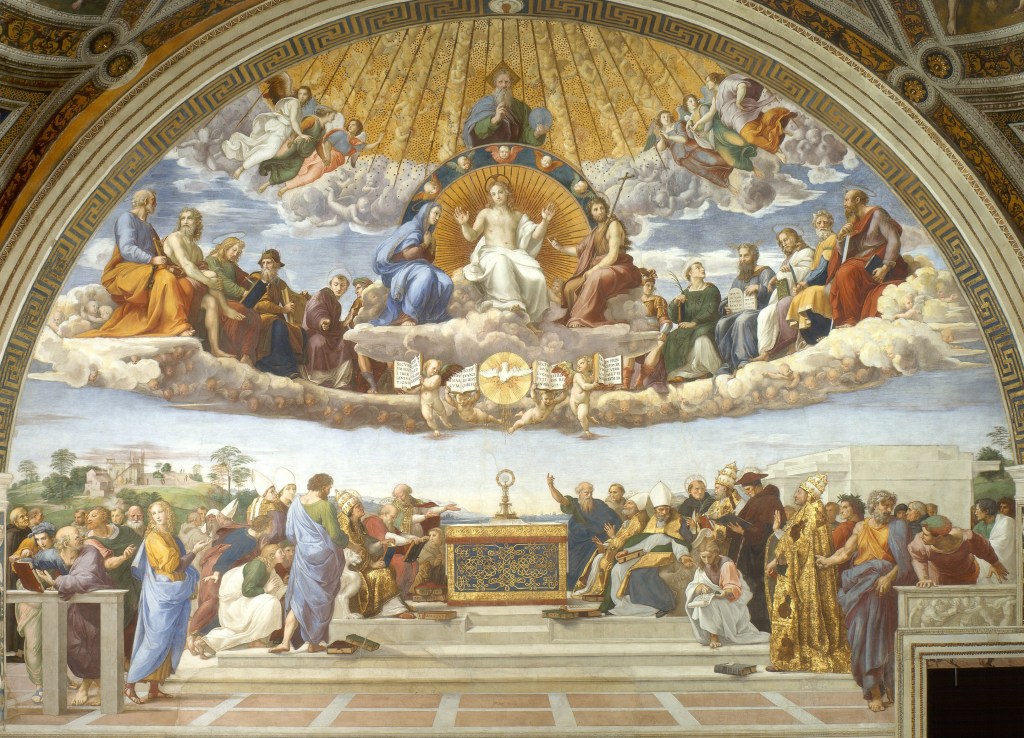
“The Disputation of the Holy Sacrament,” fresco by Raphael (1509–1510), Vatican City.
• Some claim the idea of the Mass as a sacrifice was a later Catholic invention, but the writings of the early Church tell a different story:
• The Didache (c. 50-100 AD) calls the Eucharist a “sacrifice” (Didache 14:1).
• St. Ignatius of Antioch (c. 107 AD), a disciple of John the Apostle, wrote that the Eucharist “is the flesh of our Savior Jesus Christ, which suffered for our sins” (Letter to the Smyrnaeans 6:2).
• St. Justin Martyr (c. 155 AD) identified the Eucharist as the pure offering prophesied in Malachi 1:11 (Dialogue with Trypho 41).
• St. Irenaeus (c. 180 AD) called the Eucharist “the new sacrifice of the New Covenant” (Against Heresies 4:17:5).
• If the early Christians saw the Eucharist as a sacrifice, why should we reject it today?
If Christ’s Sacrifice Was Perfect, Why Do We Need to Keep Going to Mass?
• Jesus Himself answers this: “Unless you eat the flesh of the Son of Man and drink His blood, you have no life in you” (John 6:53).
• Just as we need physical food to sustain life, we need spiritual food to sustain grace.
• The Mass is not about repeating Christ’s sacrifice but about receiving its graces. It applies His once-for-all sacrifice to us today.
• Sin weakens us, and the Eucharist strengthens us against sin, forgives venial sins, and deepens our union with Christ.
• The Last Supper established the New Covenant (Luke 22:20), and just as Israel renewed their covenant through the Passover, we renew our participation in Christ’s covenant through the Eucharist.
• Worship is ongoing in heaven. Revelation 5 describes a heavenly liturgy where Christ appears as a Lamb standing as though slain. When we celebrate the Mass, we are joining in this eternal worship.
Listening to the Heschmeyer-White debate reaffirmed the beauty of Catholic teaching. The Mass does not contradict Christ’s “once for all” sacrifice—it makes it present for us today. The Protestant concern that the Mass “re-sacrifices” Christ is based on a misunderstanding. The Church teaches that Christ’s sacrifice is perfect and complete, but that does not mean we stop participating in it. The early Christians saw the Eucharist as a sacrifice, and Scripture itself supports this understanding.
So the next time someone asks, “Why do Catholics believe the Mass is a sacrifice?” you can confidently say: Because Christ’s sacrifice is eternal, and the Mass is how we participate in it!


 The Rosary Dad
Leave a comment